
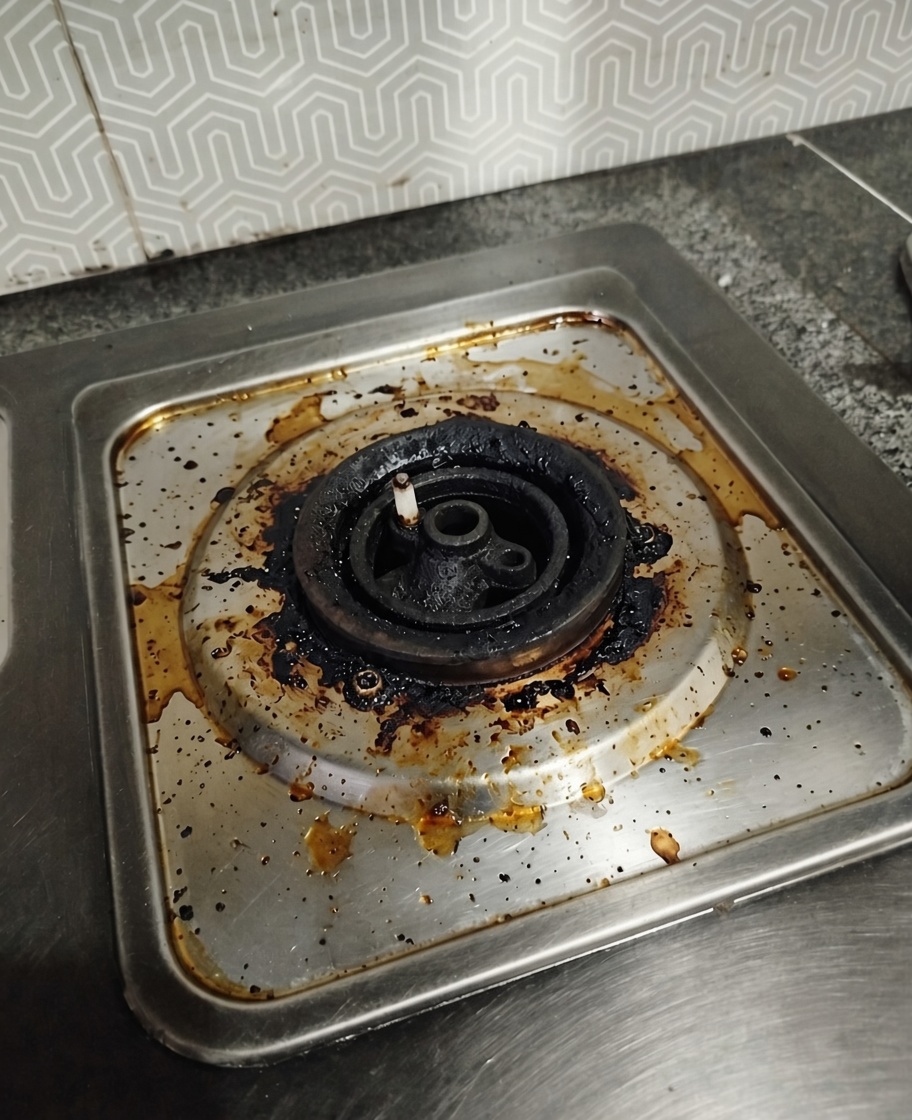
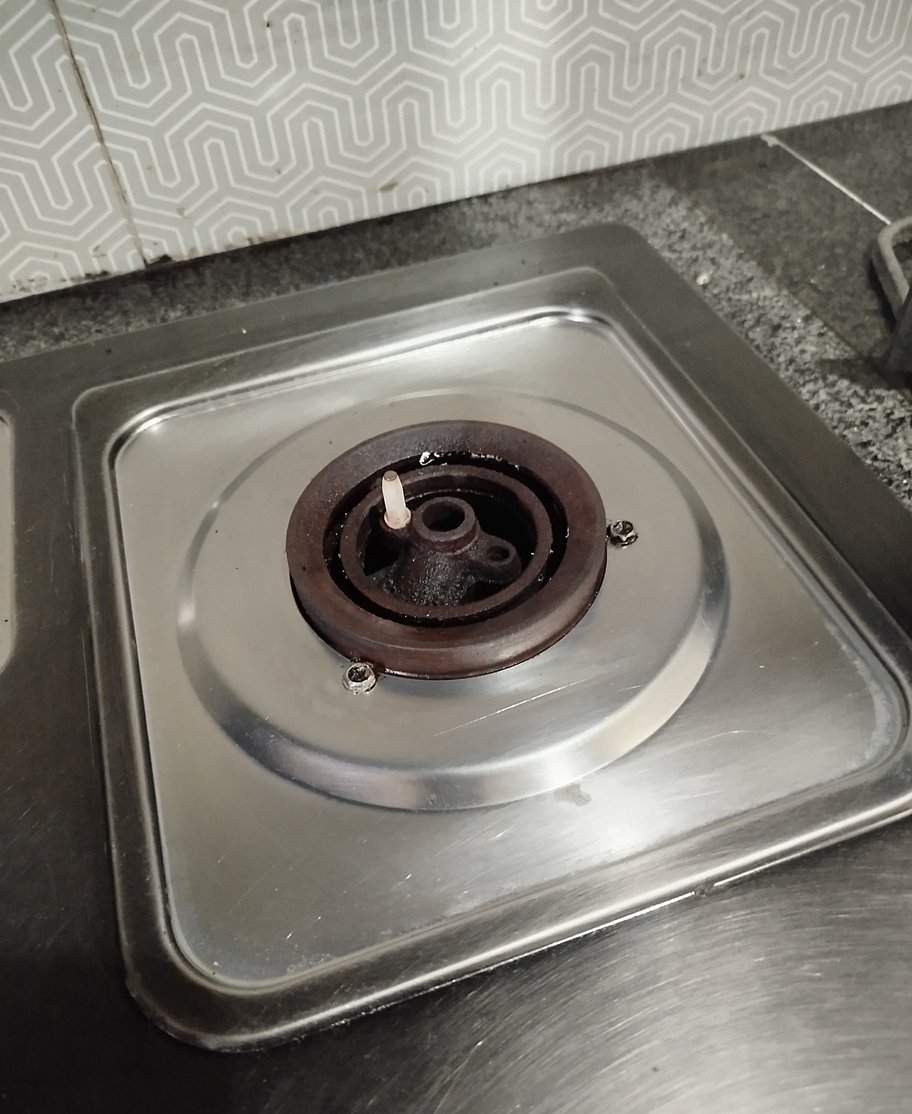
As a Kitchen Degreaser: Burnt Grease, Oil & Carbon
Burnt cooking oil does not behave like ordinary dirt. Every time a pan splatters, the oil lands hot, cools, and mixes with dust and moisture into a sticky film. Layers build on top of each other until wiping with a wet cloth just smears them around. Removing that film is the whole job of a degreaser: the formula has to break the oil down and lift it off the surface so a normal cloth can carry it away.
That is also why a dedicated degreaser and a general kitchen cleaner spray behave differently. The cleaner is for light daily wiping. The degreaser is for the heavy layer that has already hardened — the ring around each burner, the hood filter that has gone amber, the tiles that have lost their colour under a coat of cooking film. MOPP sits on the degreaser side of that line: strong enough for burnt-on layers, simple enough for a weekly fifteen-minute routine.
Where the Degreaser Works Hardest
- Stovetops & burners — the burnt ring around each burner and the greasy tray under the grates.
- Range hoods & exhaust filters — the heaviest grease load in the whole kitchen.
- Backsplash & wall tiles — the invisible film that makes tiles feel tacky and look dull.
- Cabinet shutters near the stove — sticky panels that catch airborne oil every time you fry.
- Sink & counter edges — the grime line where the counter meets the sink.
- Fryer zone & air-fryer exteriors — oil mist that lands around the frying corner.
As an Oven Cleaner: Burnt Grease, Carbon & Baked-On Grime
An oven hides its dirt well — until the day you turn on the light and see it: a brown varnish of baked grease on the walls, black carbon on the base, and a door glass that has gone hazy. That film is not ordinary dirt; it is cooking oil that heat has polymerised, layer after layer, into a tough, varnish-like coating that water-based wiping barely touches. Pakistani cooking is hard on ovens for the same reason it is hard on stovetops: marinated trays drip curry oils that smoke and settle on the walls, roasts splatter fat at high heat, and the grease bakes harder and faster than in a typical Western kitchen.
The MOPP routine for oven interiors is the same discipline as the stovetop, with more patience: start with a fully cooled oven, take the racks out to clean separately, then spray the walls, base, top and the inner door glass — keeping the spray off the heating elements and fan motor. Give it 5–10 minutes of dwell time, because burnt carbon softens through contact, not force. Wipe the softened film off with a cloth, re-spray whatever still resists rather than scrubbing, and finish with a water-damp pass.
The door glass and racks are the two details everyone notices. The haze on the glass is condensed grease, and it comes off the same spray-wait-wipe way — do both inner panes if your door opens for cleaning. Racks are the easy win: lay them in the sink or on old newspaper, spray both sides, give them several minutes, then wipe and rinse under warm water. Deep, years-old carbon may take two or three sessions; that is the carbon being stubborn, not the method failing.
As a Grease Remover: Sticky Oil Film, Splatter & Grime
Kitchen grease is not one problem but several: the invisible mist that lands on shutters while you fry, the splatter corridor behind and beside the stove, the amber coat on the exhaust fan blades, and the tacky film that makes wall tiles feel dirty even after wiping. Every time oil heats in a pan, a fine mist of it travels through the air; over weeks the particles form a skin on every surface within a metre of the stove, dust sticks to that skin, kitchen moisture thickens it, and the layer slowly turns from oily to tacky to hard.
This is why "wiping with water" fails: water does not dissolve oil, so a wet cloth mostly moves the grease to the edges of where you wiped. A grease remover — an oil remover in plain terms — is formulated to break the oil itself down, so the film releases from the surface and comes away on the cloth. For layers that have been building for months, do not expect one pass: spray, wait, wipe, and repeat on the stubborn patches — old grease softens in rounds, each application taking a layer off. That patience is what separates a real kitchen grease cleaner from a fragrant all-purpose spray.
- Cabinet shutters beside the stove — the first place airborne oil lands and the first place it hardens.
- Wall tiles & backsplash — the splatter corridor behind the burners.
- Exhaust fan blades & hood filter — the greasiest spot in most homes.
- Counter edges & joints — the grime line where counter meets wall or sink.
- Around the fryer / air fryer — oil mist settles on every nearby surface.
As an Everyday Kitchen Cleaner: One Bottle, the Whole Kitchen
Most kitchens end up with a small army of bottles — a countertop cleaner for the counters, a stove spray, a sink product, something for the glass. The everyday reality is simpler: nearly every kitchen surface collects the same two things, splashes and cooking grease, and one kitchen cleaner spray that actually cuts grease covers the whole room. After cooking it works as a countertop cleaner on the slabs, takes care of cabinet cleaning on the shutters that catch frying mist, and doubles as an appliance cleaner on the fridge and microwave exterior — a 60-second wipe-down that stops today's splashes from becoming tomorrow's film. The weekly deep clean — stovetop rings, tiles, hood filter, shutters — is where the degreaser side of the same formula earns its keep. One bottle, both jobs, which is exactly why it replaces the army of half-used sprays under the sink.
- Counters & slabs — the daily wipe after cooking; cuts the grease film soap leaves behind.
- Stovetop — daily splashes; weekly deep clean of the burnt rings.
- Sink & tap — the grime line at the joint and water-marked chrome.
- Fridge & freezer exterior — the sticky fingerprints and cooking mist layer.
- Wall tiles & backsplash — the splatter corridor; weekly pass keeps them bright.
- Range hood & shutters — the heavy-grease fortnightly deep clean.
Why Households in Pakistan Keep a Bottle in the Cabinet
MOPP comes as a 430 ml trigger spray at Rs. 499 — order the 2-Bottle Pack (Rs. 999) and a free gift is added, or the 3-Bottle Pack (Rs. 1,499) with a free gift and free delivery. You spray, you wait a couple of minutes, you wipe. No buckets, no gloves-and-scrub routine, no mixing anything.
It is manufactured in Islamabad by Moppchem Manufacturing — not imported, not repacked — and every order is delivered cash-on-delivery, so you inspect the bottle before you pay. Delivery is Rs. 150 for a single bottle, Rs. 100 for the 2-Pack and free on the 3-Bottle Pack.
What Kitchen Cleaning Products Cost in Pakistan (2026)
Kitchen cleaner and degreaser prices in Pakistan currently run from roughly Rs. 300 for small imported sprays to well over Rs. 1,000 for large 3–5 litre industrial formats. What the shelf price does not show is the maths per clean: a kitchen grease cleaner that actually cuts grease gets used in mists, while a weak cleaner gets emptied in floods because you keep re-spraying the same patch.
MOPP sits deliberately in the practical middle: Rs. 499 for 430 ml — with the 2-Bottle Pack (Rs. 999 + a free gift) and the 3-Bottle Pack (Rs. 1,499 + a free gift + free delivery) rewarding larger orders. Local manufacturing keeps the price honest, and cash on delivery means you check the bottle before paying. An average household uses one bottle roughly every two to three months with the weekly routine above.
The Four-Step Routine — Same for Stovetops, Tiles and Oven Interiors
- Spray directlyMist the greasy area evenly from about 15 cm — stovetop rings, tiles, shutters or a cool oven interior. Thick, hardened layers want a proper wetting, not a light dusting.
- Give it 2–3 minutes (5–10 in an oven)The formula needs dwell time to break the oil film down. Burnt carbon inside an oven is the thickest grease in the kitchen: use the longer end, and re-spray patches that are drying out.
- Wipe with a dry clothThe lifted grease comes off on the cloth in one pass. Fold the cloth to a clean face as you go — you are collecting oil, not spreading it.
- Finish with a damp wipeA quick pass with a water-damp cloth leaves the surface clean and streak-free. Let a cleaned oven air out for 15–20 minutes before the next bake.